home, presentations, press, artwork, bio, project background
Melissa F. Pheterson
For Rochester Magazine
Scoring an original work of art doesn’t always cost wads of cash. Crisp linens and baked beans will do just fine if you’re hosting Jim Mott. For the second time, the Pittsford artist has painted his way across the United States as part of his Itinerant Artist Project Tour.
Mott bunks with gracious hosts across the country, then thanks and repays them with a painting inspired by the visit: a wildflower, a pick-up truck, the view from a home’s front door. In November, Mott returned from a six-week road trip, starting in Seattle and working his way back home.
He calls his initial cross-country tour, in 2000, “a life-defining journey.” In between, he confined his trips to shorter jaunts across New York and New England. But once he felt the seven-year itch—plus an impulse to see the Northwest—he knew it was time to strike out again.
He worked the phones and the Web until clusters of willing folks popped up, from the stepbrother of a friend’s friend to the reference librarian at Montana State University, where Mott had called to seek accommodations near Yellowstone. Mott plotted his route around their welcome mats, then bought a Chevy Prizm on-line and a one-way ticket to Seattle. He would make 15 stops in 10 states.
If that sounds like the ultimate escapist adventure, consider this: Mott is an admitted introvert.
“I was pretty much on edge and terrified for the first few weeks,” he says.
So why subject himself to it? Mott says it’s “a way to get outside my comfort zone.” The painting itself helps him acclimate and express himself in radically different environs. “Knowing my only task is to paint makes me a lot more focused than I am at home.”
And there’s a larger, philosophical point to his project. Mott seeks to extricate art from the “distractions” of the market—investing it with a value rooted more in a sense of connection than commodity.
“We both find it meaningful,” he says of presenting his parting gift. “I have trouble letting my work go if it’s sold to a stranger.” When he does sell, his paintings fetch up to $500. But when itinerant, Mott operates squarely outside the marketplace.
In his suitcase: 100 six-by-nine-inch panels made from conservation board (a special high-grade cardboard), a drying box, paint and brushes, sketch pads, his journal, a combo fan/space-heater and black cloth to drape over naked windows. Not surprisingly, he goes easy on the clothing.
In two to three days he produces four to five panels, trying to intuit the scene destined for his hosts’ walls. One man took Mott to his favorite fishing creek for his painting. But often, weary of driving, he trains his gaze on the immediate surroundings—the tree outside the window where he’s staying, or the glowing sign for a local diner. He rarely climbs back in the car, tourist-style, to ogle a scenic vista.
To Mott’s unexpected delight, the folks along the way really seemed to “get it”—even the Montana judge who actually accepted a print in lieu of payment for a speeding-ticket fine.
“Being abducted by aliens wouldn’t have surprised me more,” says Mott, who also bartered his art for free meals and museum admission. “I think people pick up on the energy of the adventure. It also gives them a chance to step outside convention and do something different.”
This time Mott leveraged his paints into publicity, too. “Although I knew a cross-country trip would be brutal,” he says, “I did it partly in hopes of reaching a broader audience, as part of a cultural dialogue.” He sent a press release to the Christian Science Monitor, resulting in a story that caught the eye of NBC’s Today Show. At a diner in Wisconsin, Mott’s mouth-watering depiction of blackberry pie became a segment in the morning show’s “American Story” series.
Though he cherishes his time with hosts, he stays in touch with precious few. “It gives it a poignant edge,” he says. “I get very close but know I’ll never see them again.” Can their cooking sustain his creativity? “I’m a vegetarian, but I tell people in advance,” he says. If they’re grilling steak, he’ll load up on baked beans.
Michael Farrell, a professor of sociology at the University of Buffalo who studies artistic collaborations, sees parallels between Mott’s adventures and the 18th-century “limner” who visited homes of patrons on commission, capturing cozy scenes in intimate settings. In those days, artists were pure craftsmen, not yet facing pressure to become merchants. “Selling work to an anonymous market doesn’t come easy, temperamentally, to a painter,” says Farrell. “Jim’s solution is to connect with his market, but on his own terms.”
In a twist on the sacred painter-patron code, this artiste captures whatever strikes his fancy. “They have to be willing to accept surprises,” says Mott, who’s as apt to paint a plastic lawn chair as a pastoral vista. He sells his remaining panels at the Memorial Art Gallery gift shop, other galleries and his Web site.
Back home in Pittsford, Mott—again free to be an introvert—recoups in solitude, quietly sketching the moon rise over Stone Road. He says that “house-sitting and living simply” have given him the freedom to be an itinerant artist, but even after buying a house and getting married later this year, he still plans to tour.
Stepping into people’s lives is such a privilege, something most artists don’t even know is possible,” he says. “That part of the tour is not scary to me. It’s the driving.”
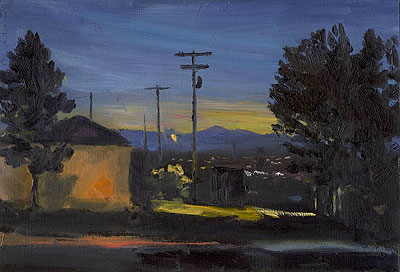
Edge of the City was the fourth of five paintings Mott completed on his second day in Salt Lake City. "It was an unusually good day," he said. "This scene caught my eye as I was heading back late for dinner. It brought back childhood memories of Tucson. And I liked the thought of painting a night scene with so much color."
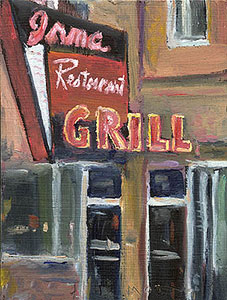
The Irma Grill was the first place Mott tried to barter a painting for a meal. "I was stuck in Cody, Wyoming with an absentee host and no food. I didn't want to spend money, so I gave it a shot." The head waitress turned him down, but he had better luck at a cowboy bar down the street. Later he went back and painted this scene, anyway, because he liked the shapes and colors of the signs.
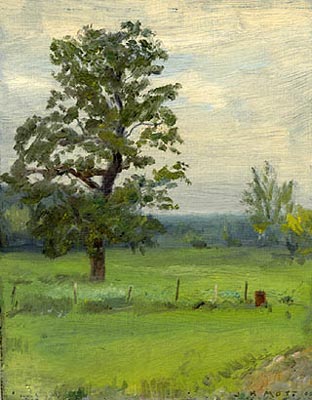
Mott painted this study called Wisconsin Oak within minutes of arriving at an old farmhouse in Stoughton, Wisconsin. He finds he can relax and settle into his visits more happily if he gets some of his work out of the way at the start.
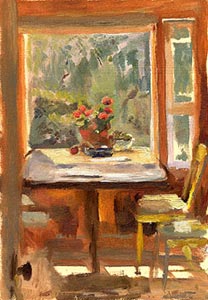
Afternoon Kitchen was painted in Litchfield, Connecticut, but a print of this scene made it into a Montana courthouse last fall, when a traffic court judge accepted it as payment for a speeding fine. "I consider that judge a creative hero of the highest order," says Mott, "and he forever re-defined the term 'fine art.'"
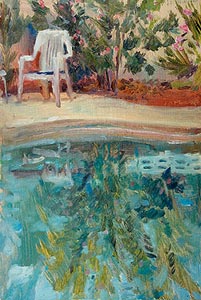
Chair by the Pool was painted in Las Vegas, after a day touring the strip with his host. "She didn't leave me much time for painting. When we got home I set to work on the first scene I could find with any interest." He worried that she might hate it, but the opposite was true. "She was delighted to see something so familiar turned into a work of art. It was one of the most rewarding responses I've ever had."
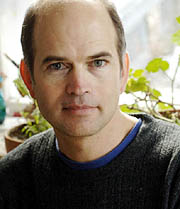
Mott will discuss the Itinerant Artist
Project at 7 p.m. Thursday, April 24,
at the Memorial Art Gallery.