At right is part of an abstract diagram I use in presentations to explain how I was thinking about social influences and interactions when planning my project. The full image is presented below (with a bit more explanation), along with a few examples of the kinds of non-painting imagery that are included in the Powerpoint presentations.
These various images add visual variety while helping to fill out a sense of the project and the creative process in general
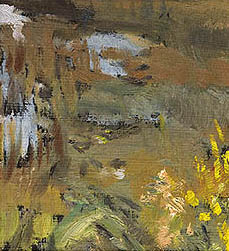
The second image at right is a detail of the painting Bass Harbor Marsh (see paintings displayed on the main Artwork page). My painting technique can be very loose up close, revealing my fondness for Abstract Expressionism. But step back, and the landscape imagery resolves into something that can look almost photographic. The participation of both representational and abstract concerns, and the tension between them, is important to my work and helps keep the small paintings alive and breathing.
Most of the images below show my interest in pattern and abstraction. People attending my presentations tend enjoy this imagery. The more sophisticated artists are pleased to find out there's more going on than landscape painting. The non-artists seem to enjoy having a different way of looking at things. We live in a highly visual culture, and yet many people have never thought about exploring visual consciousness or ways of seeing.
MORE IMAGES FOLLOW:
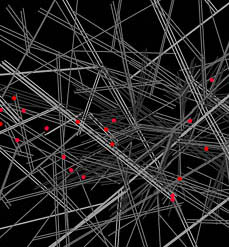
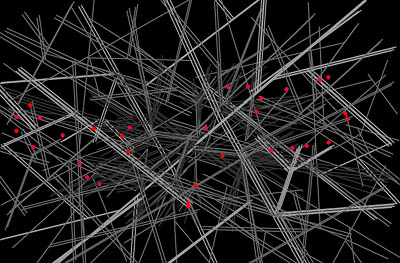
The Web of Interconnections
We exist within an infinite web of interactions and influences. This network is the context for everything we do, the fabric of meaning and motive out of which art or any other creative assertion arises. And, with my Itinerant Artist Project, that web of interconnections itself became, in a sense, my medium.
Note: while I have a support website and use the Internet to facilitate the project, the connections I'm exploring are primarily actual, non-virtual, beginning and ending in the will to share concretely and face to face with others.
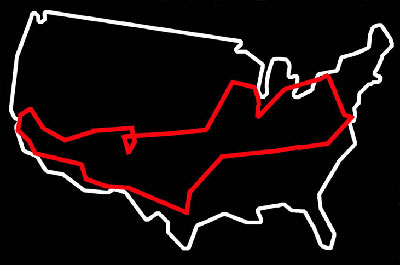
Graphic for the First Tour
The mesh in the diagram above is arbitrary but suggestive. The red dots could be random but correspond to the map locations for the 32 stops on my first Itinerant Artist tour.
Connecting the dots shows my route. This graphic became a logo for my project.
To some degree the location of my stops is indeed random, the end result of a few rolls of the dice, so to speak.
My favorite part of the tours is the finding of hosts: casting a net, observing how the process works, and seeing where on the map I get to place the next dot, the next stop in my itinerary.
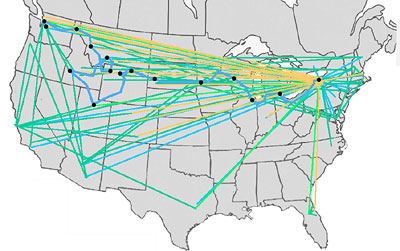
This graphic shows pathways for some of the tour announcement emails I sent out for the 2007 tour; where those got forwarded and who ended up responding.

Classified Ad
The means by which people hear about my project and decide to invite me have expanded along with media coverage*. Mostly, though, I have relied on email chain letters (not the bad luck kind); classified ads; word of mouth and my web presence.
More recently, when needing a host in a target location, I have tried cold-calling art departments, reference librarians, museums, etc.
*an aside: My interview on Canadian public radio led to several dozen invitations, including one from the Gaza Strip. "You might have trouble getting back out, but you'd have an interesting time," she wrote.
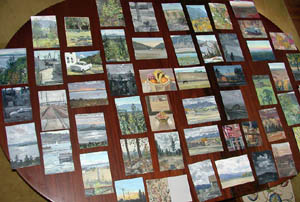
55 Panels, Before and After
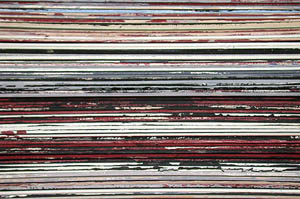
This is a side-view of the stack of panels I took on my last tour. They are primed with gesso of different colors ( I have published articles about painting on colored gesso).
After snapping this shot, I headed to the airport with a one-way ticket to Seattle and license plates for a '98 Chevy Prizm I'd bought on CraigsList Seattle. This was the latest strategy for throwing myself way outside my comfort zone and into an art road trip with no easy retreat.
The reality of touring is always highly unpredictable and highly demanding, especially given my tendency to be socially retiring, to dread long drives, to dislike being uprooted and to sleep terribly in unfamiliar places. On top of all that, there's the inherent uncertainty of art itself: I really never know if I'll be able to paint adequately on any given day, yet alone 40 days more or less in a row...
But with a road trip, as with a painting, I like finding out what happens. I like finding out that, in fact, in spite of it all, I have the ability or the openness to let it work. That may be one of the deeper motivations behind my painting, as well as my art trips.
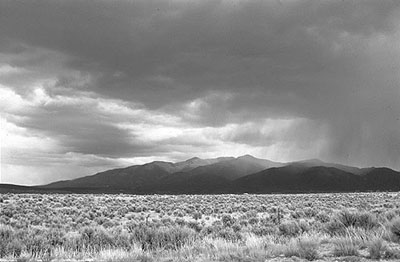
Northeast of Taos
I have hundreds of photos from my tours, many of which I use in my presentations, to give a greater sense of the project's geographic scope. They were originally shot in color, but I show them in B&W so that they don't compete with the paintings. I would do the same for any included in American Road Artist.
A Couple More Sample Photos:
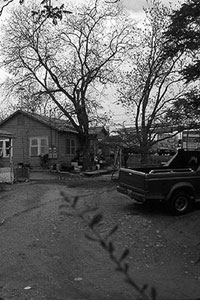
The photo at left is from one of my least favorite stops, in Denton, Texas. My hosts were good hearted art lovers, but nutty. They were also absentee landlords living on a quiet fringe of the city. For some reason their idea of hospitality was to put me in a small wing of their rental property, half a block from the expressway. Dinner was all the mixed vegetables and hot dog rolls I cared to thaw out from the freezer.
Of course the worst times often make the best stories.
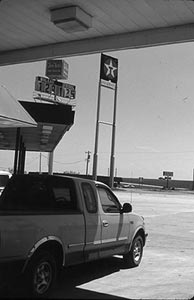
I took this photo (at left) because a lot of my life on the road is...on the road. Here I'd just reached Oklahoma from Arkansas on my first tour, and to me it looked like I'd just entered the West. A careful look reveals that the price of gas in 2000 was around $1.25 per gallon.
The original Itinerant Artist Project Logo
Itinerant Artist Project website: www.jimmott.com
Contact: jhmott@juno.com